“Better” depends on what you value most: consistency, price, customization, ingredient transparency, performance, or the story behind the product. Soy candles can be excellent in both handmade and factory-made forms, but they often differ in how they’re formulated, poured, cured, tested, and quality-controlled. This guide breaks down the real-world differences so you can choose confidently—whether you’re buying for yourself, gifting, or stocking a retail shelf.
What “Handmade” and “Factory-Made” Usually Mean
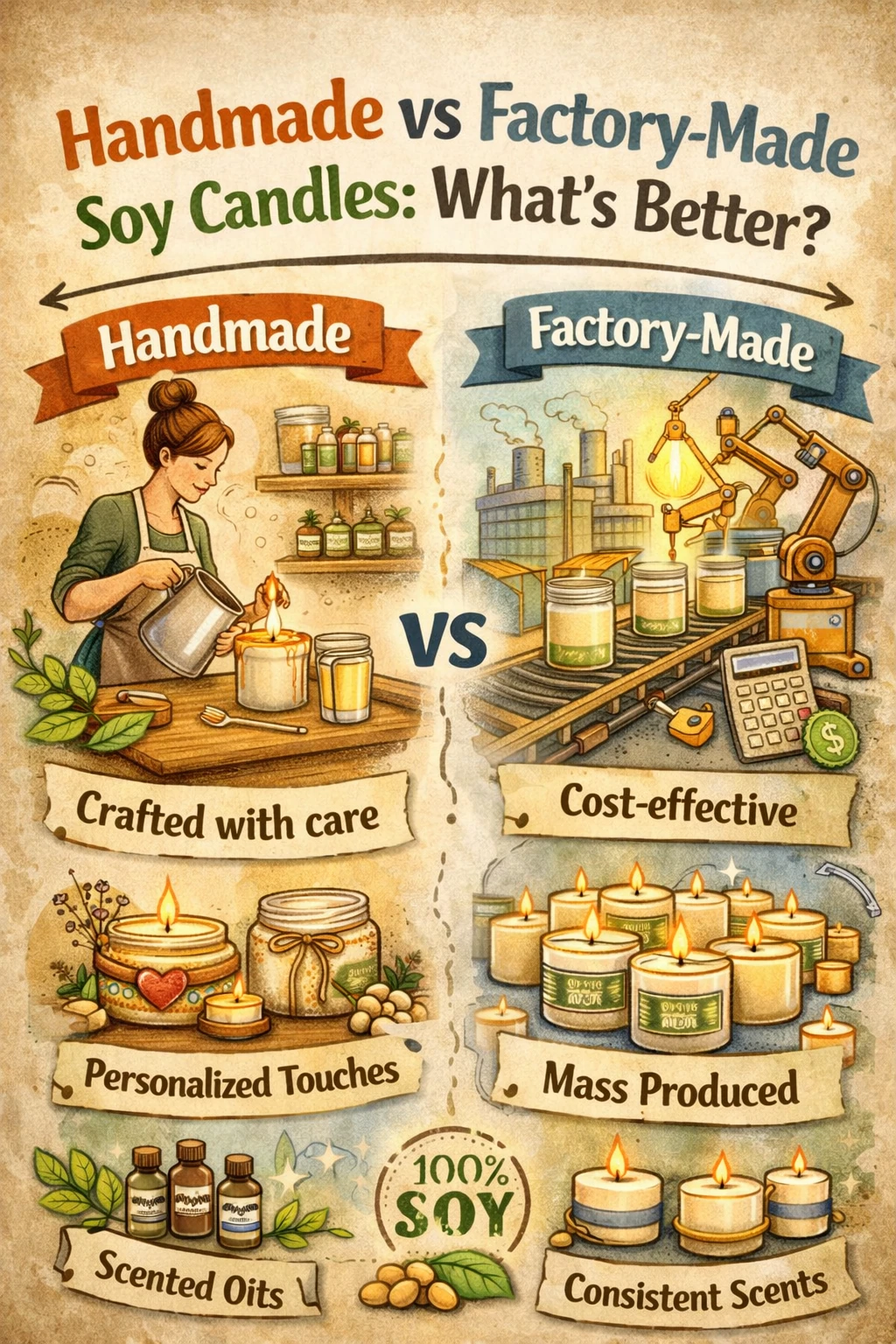
“Handmade” typically refers to small-batch production where people measure, heat, blend, and pour wax with direct hands-on steps—often in studios or small workshops. “Factory-made” usually means larger-scale production using standardized procedures, industrial melters, automated or semi-automated filling lines, and batch tracking. These labels are not guarantees of quality by themselves; a careful small maker can outperform a factory, and a well-run factory can outperform a rushed small maker. The useful question is not the label—it’s how the candle is designed and controlled from raw material to finished burn.
Performance: Burn Quality, Hot Throw, and Consistency
A candle’s performance is largely determined by the relationship between wax blend, wick type/size, fragrance load, vessel size, and cure time. In theory, both handmade and factory-made soy candles can deliver clean burns, strong scent throw, and good burn times. In practice, the most common difference is consistency between units.
Factory-made candles often excel at repeatability because the process variables are tightly controlled: wax temperature, pour temperature, mixing speed, fill weight, wick placement, and cooling conditions are frequently standardized and measured. This can reduce surprises like uneven melt pools, tunneling, or weak scent in one jar compared with the next.
Handmade candles can match that consistency, but it typically requires disciplined testing and documented procedures. When small-batch producers take testing seriously—multiple wick trials, fragrance stability checks, cure-time validation—performance can be outstanding. The tradeoff is that handmade products may show more variation when makers scale too quickly, change suppliers, or skip extended testing on new fragrances and vessels.
Ingredients and Transparency: What’s Actually in the Candle?
Soy wax sounds simple, but commercial “soy” candles can contain blends—soy plus other vegetable waxes, and sometimes additives that improve smooth tops, adhesion, scent throw, or burn behavior. Additives are not automatically bad; they’re often used to solve real performance problems. The key is whether the candle is honest about what it is and how it behaves.
Handmade brands sometimes provide more direct ingredient transparency—especially when the maker is the person answering your questions. You may be able to ask what wax blend is used, what wick type (cotton, paper-core, wood), whether dyes are used, and what kind of fragrance oils are selected. That said, “handmade” doesn’t guarantee disclosure; some small makers use pre-blended waxes and proprietary fragrances and may not know every component.
Factory-made candles may provide less detailed ingredient storytelling on the label, but they can be strong on documented compliance, safety testing, batch traceability, and standardized material specs—especially for brands that sell through large retailers or multiple countries. For many buyers, documentation and repeatable safety standards are a form of transparency too, even when the packaging keeps the story short.
Scent Experience: Complexity, Strength, and “True-to-Notes” Fragrances
The scent you notice comes from fragrance formulation, the wax’s ability to bind and release that fragrance, and how the candle is wicked and cured. Some factory-made lines aim for broad mass appeal: familiar profiles, stable performance, and consistent strength across locations and seasons. That can be a huge advantage if you want a reliable “smells like it did last time” experience.
Handmade candles often shine when you want unusual blends, limited editions, or more nuanced scent stories. Small makers can iterate quickly, source niche fragrance compositions, and release seasonal runs without the long lead times of industrial procurement. If you love discovery—scents inspired by places, moods, or culinary notes—handmade can be the more exciting category.
One practical note: a stronger candle is not always a “better” candle. Many people prefer balanced hot throw that fills a room without becoming overpowering. The best choice depends on your space size, ventilation, scent sensitivity, and whether the candle is for occasional ambiance or frequent daily use.
Quality Control: Defects, Variability, and How Problems Are Handled
Common candle issues include tunneling, sooting, drowning wicks, off-center wicks, frosting (a natural appearance change in soy), sinkholes, wet spots, and inconsistent scent strength. These issues can show up in both handmade and factory-made products—just for different reasons.
Factories often reduce defects through standardized equipment and inspection steps. However, when defects occur at scale, they can affect many units at once. On the other hand, the return/replacement process can be streamlined if the brand has customer service infrastructure.
Handmade makers may catch defects more personally—because they see and handle each jar. If a maker is meticulous, quality can be exceptional. If a maker is overwhelmed, variability can increase. A good sign in handmade brands is clear burn instructions, honest notes about soy’s natural traits, and a straightforward replacement policy.
Safety: Wicking, Vessel Choices, and Burn Instructions
Safety is not just about wax type. It’s about the full system: wick selection, vessel heat resistance, fill level, fragrance behavior, and how the candle is expected to be burned. A safe candle is one that has been tested to burn predictably within normal use.
Factory-made candles often benefit from established safety programs, standardized vessels, and documented testing protocols. Handmade candles can be equally safe when the maker tests properly and uses heat-rated containers, stable wick tabs, and correct wick sizing for the diameter.
From a buyer’s perspective, look for practical safety signals: clear instructions, recommended burn time per session, trim-the-wick guidance, and warnings about drafts, pets, children, and leaving a candle unattended. A well-made candle respects the reality of how people use candles at home.
Sustainability: Soy as a Material vs the Full Lifecycle
Soy wax is often marketed as an eco-friendlier alternative, but sustainability is more than the wax label. It includes sourcing, shipping distances, packaging, jar reuse, and production efficiency. Factories may produce with lower energy per unit due to scale efficiencies, but they may ship farther and use more standardized packaging. Handmade makers may source locally and encourage jar reuse, but small-batch production can be less efficient if processes are not optimized.
If sustainability matters to you, look for refill programs, recyclable or minimal packaging, and practical guidance for reusing the jar. A candle that lasts well and is used fully can be more sustainable than one that is replaced early due to poor performance.
Price and Value: What You’re Paying For
Factory-made soy candles can often be priced lower because materials are purchased in bulk and production is optimized. That makes them appealing for daily use, large homes, or frequent gifting. The value proposition is usually consistency and availability.
Handmade soy candles often cost more because labor, testing, small-batch materials, and packaging costs are distributed over fewer units. The value proposition is typically craftsmanship, distinctive scent design, personalization, and the ability to interact directly with the maker. If a handmade candle burns cleanly, throws scent well, and lasts, the cost difference can feel justified—especially when it becomes part of a ritual.
Customization and Gifting: When Handmade Often Wins
Handmade candles are often easier to customize: label personalization, themed scents, event favors, custom vessel choices, or matching a brand aesthetic. For weddings, corporate gifts, or boutique retail, that flexibility can matter more than a small difference in price.
Factory-made candles can still be excellent gifts—especially when you want polished packaging and dependable availability. If you’re buying in volume and need identical units with consistent appearance, factory-made options are often simpler to manage.
How to Evaluate Any Soy Candle Before You Buy
Instead of relying on “handmade” or “factory-made” as the deciding factor, use a simple quality checklist. Check the wick alignment and stability, look for clean pours and consistent fill level, and read the burn instructions. If available, review burn-time guidance, recommended room size, and whether the brand discusses cure time and testing.
If you can smell in-person, sample both cold throw and hot throw expectations. Cold throw is what you smell when unlit; hot throw is what fills the room when burning. Some candles have a strong cold scent but perform softly when lit, while others bloom gradually and become better after a longer cure.
Also consider your practical context: small rooms need gentler candles, large open living spaces need stronger throw and wider vessels, and drafty areas demand stable wicking and careful placement. The “best” candle is the one that works reliably in your environment and matches your scent preferences.
Which One Is Better for You?
Choose handmade soy candles if you value uniqueness, artisan scent profiles, customization, boutique gifting, and supporting small creators. They’re a strong fit when you enjoy discovering new fragrances, want a specific aesthetic, or appreciate the personal touch that comes with small-batch work.
Choose factory-made soy candles if you value consistency, predictable performance, broad availability, and often a lower price per hour of burn time. They’re a strong fit for everyday use, repeated purchases of a favorite scent, and situations where you need many identical units.
The most useful conclusion is simple: quality exists in both categories. A well-tested handmade candle can be exceptional, and a well-engineered factory candle can be reliably excellent. When you judge by performance, transparency, safety, and your own preferences, you’ll end up with the candle that’s truly “better” for you.
Practical Burn Tips to Get the Best Out of Any Soy Candle
For a cleaner burn and better scent, trim the wick before lighting, keep the candle away from drafts, and allow the melt pool to reach close to the edges during early burns to reduce tunneling. Avoid excessively long burn sessions, and stop using the candle when the wax level is low. These basics can make a “good” candle feel great—and they can also prevent common problems that are often mistaken for poor quality.