Soy candles can burn cleaner than many traditional waxes, but soy alone does not automatically equal clean. The wick, fragrance load, container design, additives, and how the candle is burned all matter. If you’ve ever owned a “clean-burning” soy candle that still smoked, tunneled, or left black marks on the jar, you’ve already experienced the gap between marketing language and real combustion behavior.
The Simple Definition of a “Clean Burn”
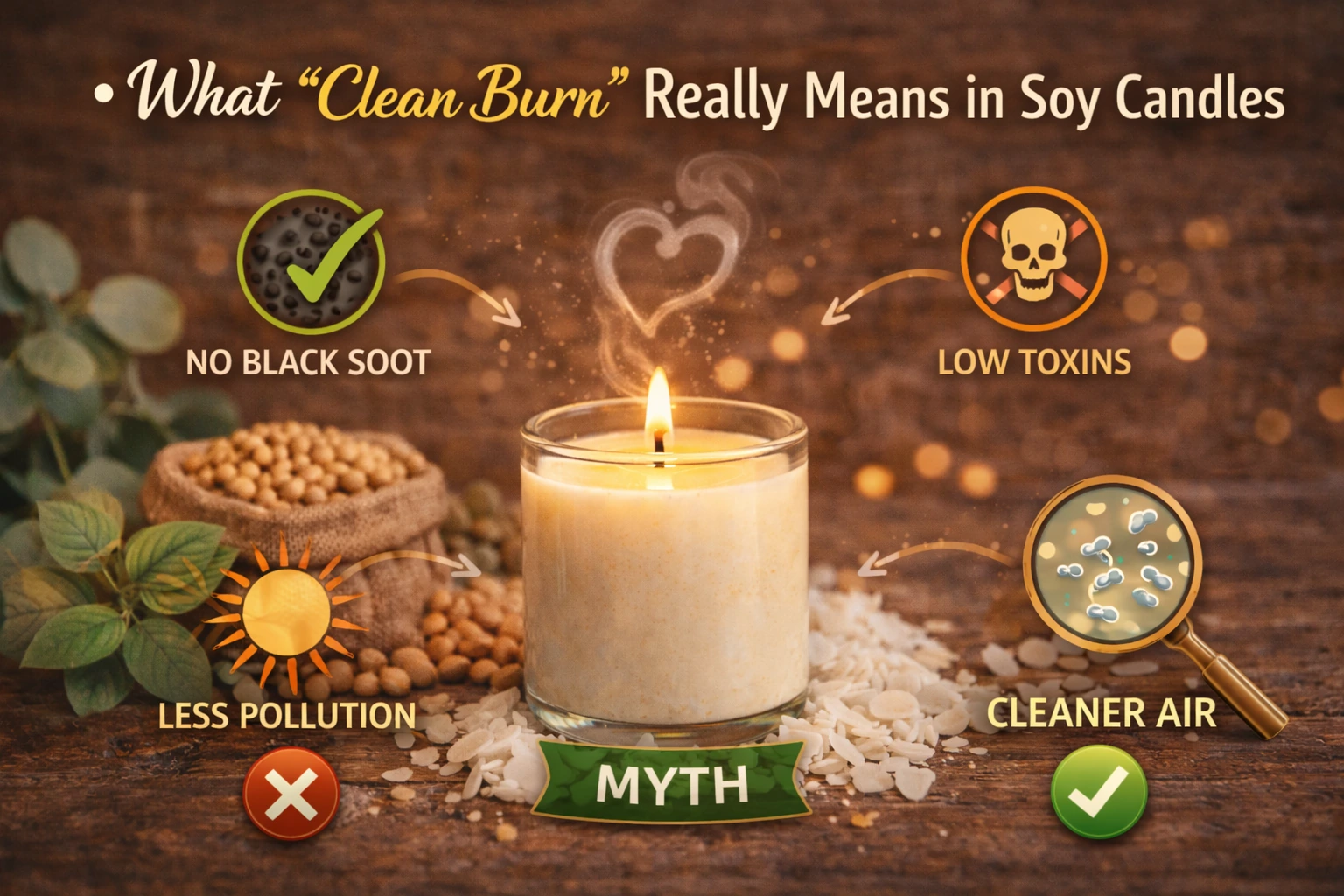
In practical terms, a candle is burning “clean” when it produces a steady flame and a stable melt pool while keeping visible smoke and soot extremely low. That’s the key idea: clean burn is mostly about what you can see and smell during a normal burn session.
A clean-burning soy candle typically shows these signs: the flame stays calm rather than flickering wildly, the wick doesn’t form a large “mushroom” at the tip, the jar remains mostly clear without heavy black streaks, and the candle releases scent without harsh, burnt notes. When extinguished correctly, it produces only a brief wisp of smoke rather than a thick cloud.
The phrase also implies a smoother burn profile—meaning the candle is not struggling. When a candle struggles, it usually shows up as heavy smoke, uneven melting, excess soot, or a wick that is either too large (overheating) or too small (tunneling and drowning).
Why Soy Is Often Associated With Cleaner Burning
Soy wax is made from hydrogenated soybean oil. Compared with many traditional wax bases, soy wax generally melts at a lower temperature and can produce less visible soot under well-tuned conditions. It often supports a gentler flame and can deliver fragrance efficiently without requiring the candle to burn extremely hot.
Another reason soy is linked to clean burn is how it behaves in containers. Many soy blends are designed for jar candles, where the wax warms evenly and creates a consistent melt pool. When the melt pool is stable, the wick receives fuel at a steady rate, which reduces the chance of incomplete combustion—the main cause of smoke and soot.
Still, none of this means soy is “smoke-proof.” A soy candle can absolutely smoke if the wick is oversized, the candle is placed in a draft, the fragrance load is too high, or the user burns it in short cycles that never allow proper melting. Soy is a good starting material, not a magic shield.
What “Clean Burn” Is NOT
One of the biggest misunderstandings is assuming “clean burn” means “zero emissions.” Any flame-based product produces combustion byproducts. Even when a candle burns beautifully, it still releases heat, water vapor, and trace gases and particles into the air. The goal of a clean burn is to minimize incomplete combustion, which is where most visible smoke and soot come from.
“Clean burn” also does not automatically mean “non-toxic” or “hypoallergenic.” People vary widely in sensitivity to fragrance and airborne particles. Some individuals may find even high-quality candles irritating, especially in small, unventilated rooms or during long burn sessions.
Finally, “clean burn” doesn’t guarantee “pure soy.” Many products marketed as soy are actually soy blends that include other waxes to improve texture, scent throw, or burn stability. Blends can still burn well, but the label “soy candle” alone doesn’t tell you the full formula.
The Combustion Side of the Story: Soot, Smoke, and Incomplete Burning
The difference between a clean-looking candle and a messy one often comes down to how complete the combustion is. Combustion becomes “incomplete” when the wick pulls up more fuel than the flame can efficiently burn, or when airflow is disrupted. When that happens, tiny carbon particles can form and escape into the air as soot, and you may see smoke rising continuously from the flame.
In a jar candle, soot usually reveals itself as dark residue near the rim or as streaks on the inside glass. On walls or ceilings, soot can show up as faint gray shadows near the candle’s usual location. If you ever notice soot building quickly, it’s a sign that something is off—often wick sizing, drafts, or over-fragrancing.
A truly clean burn is not just about avoiding an ugly jar. Soot and excessive smoke can also indicate the candle is working harder than it should, which can shorten burn time, distort scent quality, and increase the chance of overheating.
The Wick Matters More Than Most People Think
If soy wax is the “fuel,” the wick is the “engine.” You can have high-quality soy wax and still get a dirty burn if the wick isn’t properly matched to the wax, fragrance type, container diameter, and candle depth.
A wick that is too large will usually create an oversized flame, overheating the wax and pulling fuel too quickly. This is one of the most common causes of visible soot and smoky burning. You may also see a tall flame that dances, a strong “hot” smell instead of a smooth fragrance, and rapid wax consumption.
A wick that is too small causes a different kind of trouble. It may tunnel down the center, leaving wax stuck to the sides. It can also drown in the melt pool, creating a weak flame that struggles to stay lit. A struggling flame can still produce smoke, especially if the wax pool becomes messy and the wick tip carbonizes.
Wood wicks can look elegant and may burn with a softer flame, but they are especially sensitive to correct sizing and wax compatibility. Cotton wicks tend to be more forgiving, but they still require proper trimming and tuning. In clean-burn terms, the “best wick” is the one that produces a steady flame without mushrooming, smoking, or overheating the container.
Fragrance Oils: Where Clean Burn Claims Often Break Down
Fragrance is usually the whole reason people buy candles, but fragrance oils are also one of the biggest variables in burn quality. A candle can be “clean” in the first hour and smoky in the second if the fragrance load pushes the formula past what the wick can handle.
When a candle is over-fragranced, the wick may struggle to burn the extra aromatic material cleanly. This can increase carbon buildup at the wick tip and cause mushrooming, which often leads to soot. Some scent profiles—especially heavy gourmands, deep resins, or very dense “perfume-like” blends—can be harder to burn cleanly without careful wick selection.
It’s also worth knowing that “essential oil candle” does not automatically mean clean. Certain essential oils can be volatile, can behave differently at heat, and may require different wick strategies to avoid burning too hot or producing a sharp aroma. The clean burn conversation is less about whether the fragrance is natural or synthetic and more about whether the candle is formulated and tested to burn smoothly with that specific scent.
Dyes, Additives, and “Soy Blends”
Many soy candles include small amounts of additives to improve performance. Some are added to increase scent throw, smooth the wax surface, or reduce frosting (the white crystalline look that some soy wax develops). These additions are not automatically bad, but they change how the candle burns, and they can affect how “clean” the flame looks.
Dyes can also play a role. Deeply colored candles sometimes show more residue over time, and in some cases the added material may contribute to wick buildup. A clean-burn soy candle is often lightly tinted or undyed, especially in products that prioritize low soot.
“Soy blend” can mean many things. Some blends include other vegetable waxes to enhance stability, while others may include a small portion of different wax types to improve hot throw. The blend itself isn’t the problem. The real question is whether the candle has been built and tested so the wick, wax, and fragrance work together without smoke.
How to Tell if a Soy Candle Is Truly Burning Cleanly
The easiest way to judge a clean burn is to observe the candle during a normal session in a calm environment. A clean-burning soy candle should form a melt pool that gradually expands toward the edges without extreme bubbling or aggressive flickering. The flame should look stable and proportional to the jar size.
Pay attention to the wick tip. A tiny amount of darkening is normal, but a large “mushroom cap” can be a warning sign. Mushrooming often appears when the wick is carbonizing faster than it should, which can lead to soot. A candle that needs constant re-lighting, produces repeated bursts of smoke, or smells burnt instead of fragrant is usually not achieving a clean burn in real-world use.
Also check the container. A clean-burn candle does not leave heavy black streaks after a few hours. Light haze can happen over long use, but thick soot deposits suggest the candle is overheating, burning in a draft, or using a wick/fragrance combination that is not well tuned.
Why Your “Clean Burn” Candle Might Still Smoke
Even a well-made soy candle can smoke if the environment or burn habits aren’t candle-friendly. Drafts are a major factor. HVAC vents, fans, open windows, and even frequent walking past the candle can disturb airflow and cause flickering. Flickering leads to incomplete combustion, which increases smoke and soot.
Wick length is another big one. A wick that is too long creates a larger flame and more carbon buildup. This is why wick trimming is not just a “nice-to-have” ritual—it’s a real performance control. A properly trimmed wick helps the flame stay efficient and reduces soot risk.
Short burn cycles can also sabotage clean burning. If you light a candle for a short time and blow it out before it develops a stable melt pool, the wax may tunnel and the wick can become less stable over time. Later burns may become smokier as the candle struggles to correct that uneven shape.
Burn Practices That Support a Cleaner Flame
Clean burn is partly design and partly habit. Burning a candle in a calm, stable spot helps the flame stay steady. Keeping the wick trimmed helps prevent overheating and carbon buildup. Letting the candle burn long enough to establish an even melt pool improves future performance and helps avoid tunneling.
Extinguishing technique matters too. Blowing hard across the top can scatter smoke and push soot into the container. Using a snuffer or gently dipping the wick into the melt pool and bringing it back upright can reduce smoke at extinguishing time. The cleaner the shutdown, the cleaner the next relight.
Ventilation is a smart support strategy, especially in smaller rooms. Even a well-performing candle introduces particles into the air over time. A cracked window or gentle airflow in a larger space can keep the environment more comfortable without creating the kind of strong draft that destabilizes the flame.
“Clean Burn” and Indoor Air: A Balanced Reality Check
It’s helpful to be honest about the limits of the term “clean burn.” While many soy candles can produce less visible soot than some alternatives, any burning candle changes indoor air. For most people, occasional candle use in a ventilated space is a reasonable lifestyle choice. But if someone is extremely sensitive to fragrance, has respiratory concerns, or burns candles for many hours daily, the difference between “low soot” and “zero impact” becomes meaningful.
Clean burn should be viewed as a quality and performance goal: minimal soot, minimal smoke, stable combustion, and reduced “burnt” smell. It’s not a medical claim and not a promise that the air remains unchanged.
How to Shop Smarter for Clean-Burning Soy Candles
If you want soy candles that genuinely burn cleaner, look for makers and brands that talk about testing, wick sizing, and materials rather than relying only on buzzwords. Transparent product descriptions often mention whether the candle is pure soy or a soy blend, what kind of wick is used, and how the candle is designed to perform in a specific jar size.
Quality brands usually include straightforward burn instructions and safety guidance. That’s a good sign because clean burning and safe burning are closely linked. A company that tells you how to trim the wick and how long to burn the candle is demonstrating that they understand real-world performance.
Be cautious of candles that smell extremely strong while unlit. That can hint at a very heavy fragrance load. Strong cold throw is not always a problem, but in some formulas it can increase the chance of soot if the wick isn’t precisely tuned.
The Bottom Line: Clean Burn Is a System, Not a Sticker
“Clean burn” in soy candles is best understood as a combination of thoughtful formulation, correct wick selection, good container engineering, and proper burn habits. Soy wax can absolutely support a cleaner, lower-soot burn, but only when the candle is built and used in a way that keeps combustion stable and complete.
A clean-burning soy candle should look calm, smell smooth, and leave your jar clear. It shouldn’t produce constant smoke, heavy soot, or harsh “burnt” notes. When you choose candles made with tested wicks and balanced fragrance, and you burn them with care—trimmed wick, draft-free placement, and sensible burn times—you get the real benefits people are looking for when they shop for “clean burn.”
In the end, the cleanest candle experience is the one that performs consistently, respects your space, and delivers the atmosphere you want without turning your relaxing ritual into a smoky mess.