Soy candles are often marketed as a “greener” alternative to paraffin candles, and the claim is not pure hype. In many real-world cases, a soy candle can have a smaller carbon footprint than a paraffin candle because the wax comes from a renewable biological source rather than fossil petroleum. But “smaller” is not automatic, and it is not guaranteed. The footprint depends heavily on how soy is grown and sourced, whether land was cleared to grow it, how the wax is processed, how far the candle travels, and what else is inside the candle besides wax.
The most honest answer is a practical one: soy can reduce fossil-carbon emissions compared to paraffin, but soy can also carry a serious land-use and supply-chain footprint if it is tied to habitat conversion or deforestation. When people ask “Is soy better?”, the right follow-up is “Which soy, from where, under what rules, and compared to what alternative?”
What “Carbon Footprint” Means for a Candle
A candle’s carbon footprint is the total greenhouse gas impact across its life cycle. For candles, that life cycle usually includes the raw material stage, processing and refining, candle manufacturing, packaging, transport and distribution, and the use phase (burning). Some studies also include end-of-life impacts from jars, lids, labels, and shipping materials.
It also matters how the footprint is measured. Some analyses compare candles by weight (per kilogram of candle), while others compare them by energy content (per MJ) or by burn time. These choices can change the final comparison because different waxes have different properties and may burn differently under different wick sizes and formulations.
The Big Difference: Fossil Carbon vs Biogenic Carbon
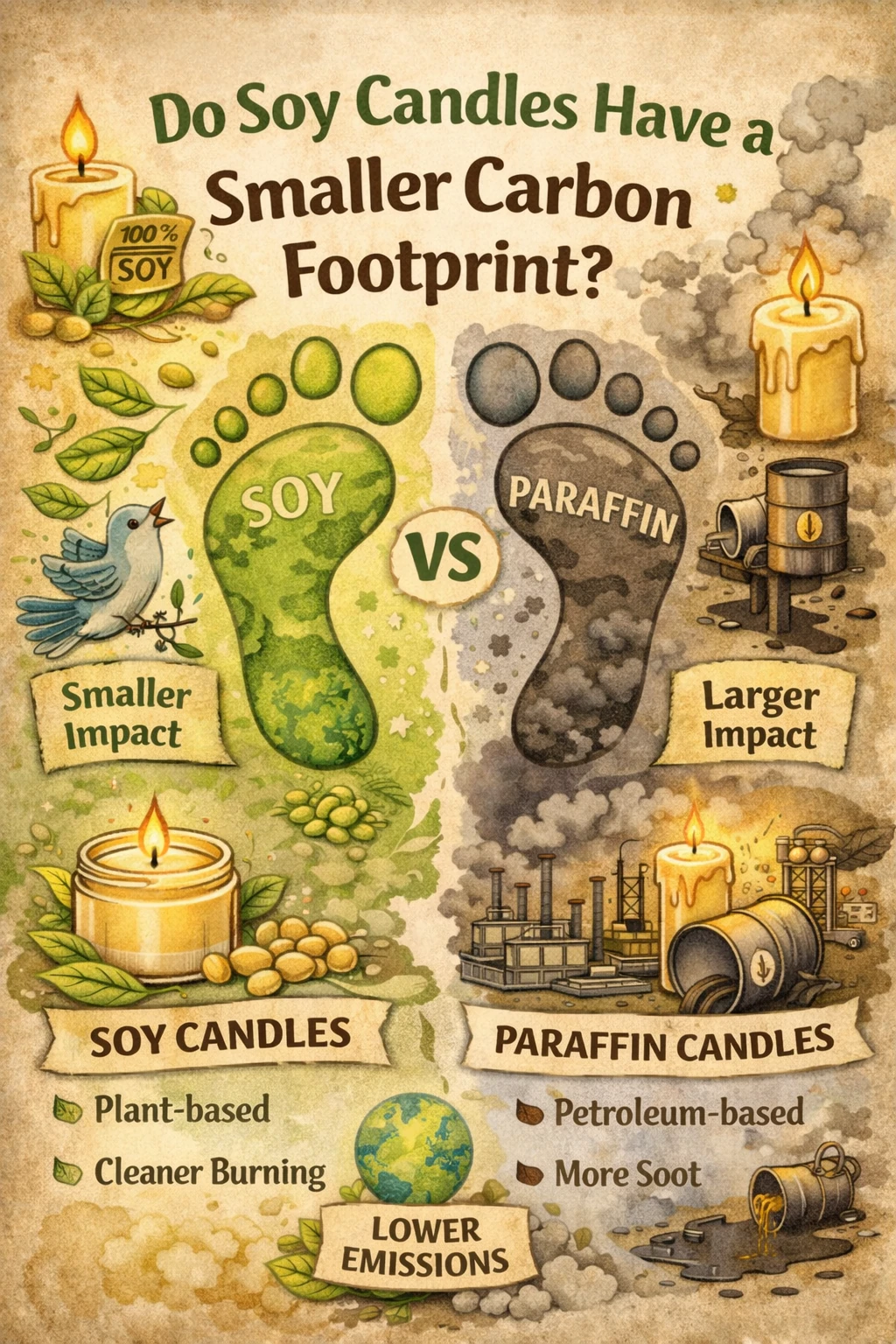
Paraffin wax is made from petroleum, which is fossil carbon. When paraffin burns, it releases fossil CO₂ that adds carbon from underground reservoirs into the atmosphere. Soy wax is made from soybean oil, which is plant-derived carbon. When soy wax burns, the CO₂ released is “biogenic” in the sense that it came from carbon recently captured by a crop from the atmosphere.
That biogenic framing is why plant-based waxes can look better in climate accounting. A life-cycle study for Nordic Swan ecolabelled candles (mostly renewable stearin with a smaller paraffin fraction) found the total climate impact was lower by roughly the mid-50% range compared to a 100% paraffin candle when measured per unit of energy and per unit of weight, with paraffin’s combustion phase dominating its impact. This is not a soy-specific result, but it demonstrates the general climate advantage you can get when a candle shifts away from fossil wax and toward renewable wax—assuming the renewable feedstock is responsibly sourced.
So Why Isn’t Soy Always the Clear Winner?
Because crops have land footprints, and land footprints can become carbon footprints. If forests, savannas, or grasslands are converted into cropland, large amounts of carbon stored in vegetation and soils can be released. That “land-use change” can overwhelm the climate benefits you expected from switching away from petroleum wax.
A WWF analysis on soy and greenhouse gases highlights how dominant land-use change can be for soy’s footprint. It notes that land-use change can add a globally averaged range in the neighborhood of about 1.2–1.6 kg CO₂e per kg of soybeans from deforestation alone, and that some sourcing locations can be several times higher depending on where and how soy expansion occurred. In other words, “soy” is not one uniform product from a climate perspective.
This is also why blanket statements like “soy candles are carbon neutral” are risky. The carbon in a soy candle may be biogenic, but the supply chain behind it can include fossil energy, fertilizer emissions, processing emissions, transport emissions, and—most importantly—potential land conversion emissions.
What Parts of a Soy Candle’s Footprint Usually Matter Most
For soy candles, the “hot spots” often shift depending on sourcing and manufacturing choices. These are the areas that commonly move the needle:
- Feedstock sourcing and land-use change: Deforestation risk and conversion of native ecosystems can dominate the footprint. Even when soy is grown efficiently, land conversion can add large one-time carbon losses that get allocated into the crop’s climate impact.
- Agricultural inputs and farm energy: Fertilizer production, on-farm fuel, and soil emissions can contribute meaningfully, and the balance varies by region and practice.
- Processing and hydrogenation: Soy wax is commonly made by hydrogenating soybean oil. The energy source used for this processing matters, and grid electricity mix can change results noticeably.
- Transportation: Shipping soy wax (or finished candles) long distances adds emissions, especially when a product crosses oceans multiple times through a complex supply chain.
- What else is in the candle: Fragrance oils, dyes, stabilizers, and blends can carry their own footprints. A “soy candle” is sometimes a soy blend rather than 100% soy wax.
- The container and packaging: Heavy glass jars, lids, labels, and shipping materials can be a meaningful part of the footprint, especially for small candles shipped individually.
Burning the Candle: The Part People Notice Most
The use phase is visible, and it feels intuitive to judge a candle’s climate impact by what happens while it burns. In life-cycle terms, burning does matter—especially for fossil wax. In the Nordic Swan climate case, paraffin candles were strongly driven by the combustion phase, while the renewable-heavy candle shifted more of its impact into the raw-material and production side instead of combustion.
For soy wax, the burning emissions are still real CO₂ in the atmosphere, but the climate accounting question becomes whether that carbon came from fossil sources or from recently grown biomass, and whether the biomass supply chain caused additional land carbon losses. This is the key nuance behind “smaller footprint” claims.
The Land-Use Reality: Soy’s Climate Story Depends on Location
Soy is grown in many regions with very different land histories and governance. Some supply chains are relatively low risk for deforestation; others are closely watched because soy expansion can be linked to ecosystem conversion. Recent reporting has highlighted the importance of policy and monitoring mechanisms such as the Amazon Soy Moratorium, which has been widely credited with reducing deforestation in monitored areas while soy production expanded—showing how rules and enforcement can change outcomes.
For candle buyers and makers, this matters because wax is upstream of the finished product. Two soy candles can look identical on a shelf while representing very different land-use risks and very different carbon footprints.
What to Look For If You Want a Lower-Footprint Soy Candle
If the goal is to choose soy candles that are more likely to have a smaller footprint, the highest-impact strategy is to reduce the chance that the wax is linked to land conversion, and then reduce avoidable emissions in packaging and transport.
- Prefer deforestation-free or conversion-free sourcing signals: Some voluntary standards and supply-chain programs focus on no-deforestation and traceability goals. When a maker can document traceability, it is usually a stronger signal than vague labels like “eco” or “natural.”
- Choose local or regional makers when possible: Fewer transport miles and fewer shipping steps typically reduce emissions, especially when the candle is heavy (glass + wax).
- Look for refillable systems or jar reuse: Reusing a jar and lid can reduce the packaging footprint substantially over time. Even a very “green” wax can lose its advantage if a heavy jar is shipped repeatedly and discarded quickly.
- Be cautious with “soy blend” ambiguity: A candle marketed as soy may include paraffin or other waxes. Blends are not automatically bad, but they make footprint comparisons harder unless the composition is disclosed.
- Consider fragrance and additives: Highly fragranced candles may carry higher upstream impacts from fragrance production. A simpler formulation can sometimes be lower impact, depending on sourcing and performance.
Ways to Reduce the Footprint Regardless of Wax Type
Wax choice matters, but the biggest footprint reductions often come from practical habits:
- Use fewer candles, less often: The cleanest burn is the one that does not happen. If candles are used daily for long periods, the total emissions add up regardless of wax type.
- Burn efficiently: Proper wick sizing and correct first-burn behavior can reduce waste (such as tunneling that leaves unused wax behind).
- Avoid over-packaging: Minimal packaging and consolidated shipping can reduce the footprint more than many people expect, especially for small items.
A Fair Bottom Line
Soy candles can have a smaller carbon footprint than paraffin candles, largely because soy wax is plant-based and can reduce reliance on fossil carbon. But the footprint advantage depends on responsible sourcing and on avoiding land-use change impacts that can dwarf the benefit of switching away from petroleum wax.
A lower-footprint soy candle is most likely to be one with transparent sourcing, strong traceability or deforestation-free commitments, reasonable transport distances, and a design that minimizes packaging waste through reuse or refills. Without those conditions, “soy” alone is not a guarantee—it is a starting point for asking better questions.