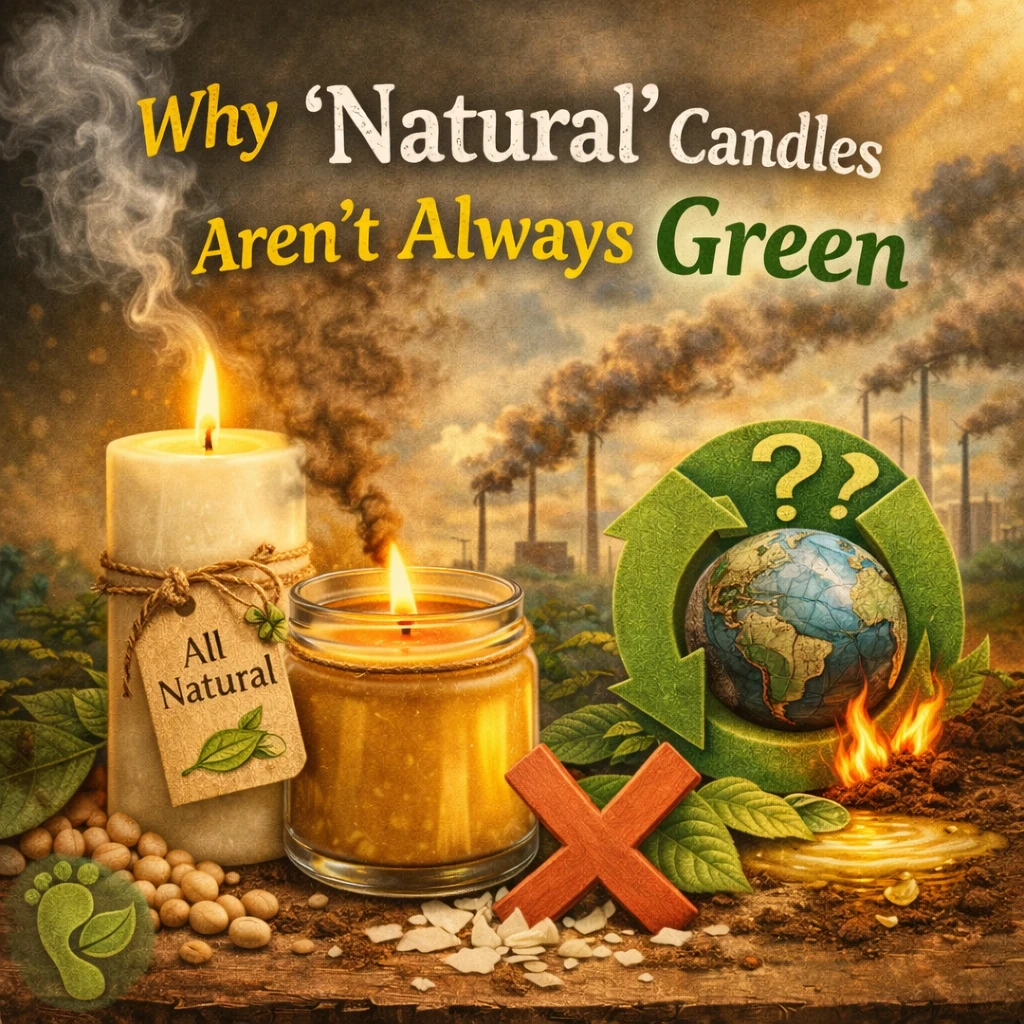
“Natural” has become one of the most powerful words in the candle world. It suggests something clean, simple, healthier, and environmentally friendly—often all at once. But in practice, natural is a marketing term more than a guarantee. A candle can be made from plant-based wax and still carry a surprisingly heavy footprint through farming, processing, fragrance chemistry, packaging, and shipping.
This doesn’t mean “natural candles” are bad or that you should feel guilty for enjoying them. It means that if you care about sustainability, you’ll get better results by looking past the label and paying attention to the whole lifecycle: where the wax comes from, how it’s produced, what else is inside the candle, and what happens after it burns.
“Natural” Is Not the Same as “Green”
A product can be natural and still be resource-intensive. Nature includes deforestation, mining, pesticides, long-haul shipping, and waste—because “natural” only describes origin, not impact.
When a candle brand says “natural,” it often means one (or more) of these:
- Plant-based wax (soy, coconut, rapeseed/canola, palm, blends)
- Essential oils rather than synthetic fragrance (sometimes partially true)
- Cotton or wood wick
- “Non-toxic,” “clean-burning,” or “chemical-free” messaging
The challenge is that none of those claims automatically guarantees a smaller carbon footprint, better land use, safer indoor air, or lower waste. “Green” is about outcomes. “Natural” is about ingredients—and ingredients are only part of the story.
The Wax Question: Plant-Based Doesn’t Always Mean Low-Impact
Wax is the main ingredient by weight, so it matters. The problem is that the most common “natural” waxes come from large, global agricultural supply chains. Agriculture can be sustainable, but it can also bring monocultures, fertilizer runoff, pesticide use, habitat loss, water demand, and significant transport emissions.
Soy Wax: Familiar, Popular, and Complicated
Soy wax is often marketed as a clean alternative to paraffin. It’s plant-based, renewable in principle, and can burn nicely when formulated well. But soy is also a commodity crop, and commodity crops come with trade-offs.
Sustainability concerns around soy wax often include:
- Land use and monoculture: Large-scale soy farming can reduce biodiversity and increase soil stress.
- Fertilizers and pesticides: Inputs can add to greenhouse gas emissions and waterway pollution.
- Processing footprint: Turning soybeans into hydrogenated wax takes energy and industrial steps.
- Long-distance shipping: Soy wax often travels across continents before it becomes a candle.
None of this means soy wax is “bad.” It means that the eco-value depends on sourcing, agricultural practices, and the rest of the candle’s design. A soy candle in a heavy, single-use container, shipped long-distance with excessive packaging, can easily lose the environmental advantage people assume it has.
Palm Wax: “Natural” with a Reputation Problem
Palm-based ingredients show up across many industries because palm oil is efficient and versatile. Efficiency can be a sustainability win—when it’s done responsibly. The issue is that palm agriculture has also been linked (in many regions) to deforestation and habitat destruction. That risk makes “natural palm wax” one of the most controversial choices for eco-minded buyers.
If a candle uses palm wax, the key question becomes traceability and standards. Without clear sourcing information, “natural” may be hiding a high-impact supply chain.
Coconut Wax: Premium Feel, Limited Supply
Coconut wax is often positioned as an eco-luxury option: smooth appearance, strong scent throw in blends, and a “clean” story. But coconut wax is also typically a processed product that may be blended with other waxes. Coconut supply chains can be complex, and the wax can travel far from where coconuts are grown to where candles are poured and sold.
The sustainability profile varies widely depending on:
- Whether the coconut ingredient is a byproduct or a primary driver of demand
- The energy used in processing and hydrogenation
- Shipping distances and packaging choices
Coconut wax can be an excellent material, but it isn’t automatically “greener” than locally sourced alternatives.
Rapeseed/Canola Wax: A Regional Advantage When Done Right
In some regions, rapeseed (canola) can offer a practical sustainability benefit: it may be grown closer to where candles are produced, reducing transport emissions. As with any crop, impact depends on farming methods. Still, “regional wax” is often a more meaningful sustainability clue than “natural wax.”
If you see rapeseed/canola wax paired with transparent sourcing and local production, that combination can be a strong sign that the brand is thinking beyond marketing.
Beeswax: Natural, Renewable, and Not Always Simple
Beeswax has a strong “back to nature” identity. It’s often associated with minimal processing, warm color, and a gentle honey-like aroma. But beeswax sustainability depends heavily on beekeeping practices and broader environmental factors.
Considerations include:
- Apiary management: Responsible beekeeping supports healthy colonies and local ecosystems.
- Exposure to agricultural chemicals: Bees can be affected by pesticides in surrounding landscapes.
- Scale and demand: Rising demand for beeswax can encourage industrial scaling, which may not always prioritize bee health.
Beeswax can be a great option, especially from transparent, small-scale producers. But it’s not a universal “green stamp.”
The Hidden Majority: Fragrance, Dyes, and Additives
A candle’s wax might be natural, but the rest of the formula often decides whether the product is truly low-impact and low-irritant. Fragrance oils, essential oils, stabilizers, UV inhibitors, and dyes can all be part of modern candle performance—and they don’t always match the “pure and green” story on the label.
Two realities are easy to miss:
- “Natural fragrance” is not always fully natural. Some brands use blends, and disclosure varies.
- Essential oils are natural, but not automatically sustainable. They can require large amounts of plant material and energy-intensive extraction.
Even when a scent ingredient is plant-derived, it may be sourced from crops that require significant land and water, or from botanicals harvested in ways that threaten biodiversity. “Natural” can still mean “resource-heavy.”
Indoor Air: “Clean Burning” Claims Need Context
Many candle buyers choose “natural” because they want a healthier indoor experience. It’s a reasonable goal, but claims like “clean burning,” “non-toxic,” or “chemical-free” are often used loosely.
Any candle that burns produces combustion byproducts. What changes is the quantity and type, influenced by:
- Wick design and sizing
- Fragrance load and fragrance chemistry
- Burn behavior (tunneling, sooting, flickering)
- Room ventilation and burn duration
A “natural wax” candle can still soot if the wick is oversized or if it’s burned improperly. A heavily fragranced candle, even if scented with essential oils, can still be irritating for some people. So, “natural” does not equal “safe for everyone,” and “green” does not only mean “plant-based.”
Wicks: Small Component, Big Marketing
Wicks are often highlighted in product descriptions because they’re visible and easy to brand: “cotton wick,” “wood wick,” “crackling wick,” “lead-free.” Most modern candle wicks are lead-free, but wick materials still affect burn quality and emissions.
What matters most is not the romance of the wick, but whether it’s engineered correctly for the wax, vessel, and fragrance. A well-matched wick reduces smoke and soot, improves performance, and can reduce waste by helping the candle burn evenly.
The Container Problem: Glass and Ceramic Aren’t Automatically Sustainable
The candle jar is often the biggest piece of waste and the biggest piece of shipping weight. Heavy glass looks premium and reusable, but it also takes energy to manufacture and adds emissions during transport.
A container becomes greener when it is actually reused or recycled. The “green” version of a jar candle usually involves:
- Refill systems that keep jars in use over time
- Standard jar sizes that are easy to repurpose
- Minimal decoration (less paint, less coating, fewer mixed materials)
- Local production to reduce shipping weight impact
When a “natural candle” arrives in a thick jar, wrapped in foam, inside a luxury box, inside another box, shipped across oceans, the environmental math changes quickly.
Packaging and Shipping: The Quiet Footprint
Candles are heavy and fragile. That combination pushes brands toward extra packaging and careful shipping methods. Sustainability claims often focus on wax, but packaging and logistics can be just as important.
Watch for green flags like:
- Plastic-free or minimal plastic packaging
- Recycled and recyclable materials
- Right-sized boxes rather than oversized “presentation” packaging
- Regional fulfillment (shipping from nearby rather than across the world)
A candle that is slightly less “natural” but produced locally with minimal packaging can sometimes have a smaller overall footprint than a fully “natural” candle shipped long-distance with lots of protective materials.
Greenwashing: When the Story Is Better Than the Supply Chain
Candle branding is emotional. It’s about comfort, ritual, mood, and identity. That makes it easy for sustainability claims to become part of the aesthetic rather than the engineering.
Common greenwashing patterns in candles include:
- Using “eco-friendly” without explaining what is actually improved
- Highlighting one green attribute (like soy wax) while ignoring heavy packaging or long-distance shipping
- Using “chemical-free” language even though all materials are chemicals in a scientific sense
- Implying that essential oils are automatically safer or greener than fragrance oils
The most reliable brands tend to be specific. They talk about sourcing regions, supplier standards, testing, container reuse, and what they are still improving—rather than relying on vague, feel-good words.
So What Actually Makes a Candle “Greener”?
If “natural” isn’t a guarantee, what should you look for? The most practical approach is to focus on a few high-impact areas where better choices are easier to verify.
These factors often matter more than a single “natural” label:
- Transparent sourcing: the brand can explain where wax and fragrance materials come from.
- Regional production: closer manufacturing usually reduces transport emissions.
- Thoughtful formulation: proper wick sizing, moderate fragrance load, stable burn behavior.
- Low-waste design: refill options, recyclable packaging, and containers meant to be reused.
- Honest language: clear claims, fewer buzzwords, and willingness to share details.
Sustainability is rarely about perfection. It’s about reducing impact where it counts and avoiding the biggest traps of “pretty packaging + vague eco claims.”
Questions Worth Asking Before You Buy
You don’t need a chemistry degree to shop smarter. A few simple questions can reveal whether a brand’s sustainability story is real or mostly aesthetic.
- Where is the wax sourced and where is the candle poured?
- Is the wax a single wax or a blend? If blended, what are the components?
- Does the brand disclose whether scents are fragrance oils, essential oils, or a mix?
- Is there a refill option, or is every purchase a new container?
- What is the packaging made of, and is it designed to be minimal and recyclable?
- Does the brand share testing practices to reduce soot and improve burn performance?
If a brand can answer these clearly, it’s often a sign that sustainability is part of operations, not just marketing.
How to Use Candles in a More Sustainable Way
Even the “best” candle becomes less green if it’s wasted through poor burn habits. Small usage changes can reduce soot, extend candle life, and lower waste.
- Trim the wick (when appropriate) to reduce smoke and keep the flame stable.
- Let the top melt evenly to reduce tunneling and wasted wax.
- Burn in a ventilated space and avoid long, unattended burns.
- Reuse the container or choose refillable designs.
- Buy fewer, better candles rather than many novelty purchases with heavy packaging.
Sustainability is a combination of product design and user behavior. You can improve the outcome of almost any candle by using it in a way that minimizes waste.
A More Honest Definition of “Green”
In the candle world, “green” is rarely a single ingredient. It’s a set of choices that add up: responsible sourcing, efficient manufacturing, sensible packaging, and a product that burns well without being overbuilt or overhyped.
“Natural” can be a good starting point—but it’s not a finish line. The most sustainable candles are usually the ones that are transparent, thoughtfully made, and designed to create less waste over time. If you want your candle habit to feel as comforting environmentally as it does emotionally, look beyond the label and follow the lifecycle.